
Laundry Renovations North Ryde

First, the advice that costs us work. If you’re planning a laundry renovation in North Ryde and the bathroom needs doing too, wait and do them together.

The two rooms usually share a wall and always share trades. Doing them together means one plumber visit instead of two, one waterproofing day instead of two, one tiler, one set of start-up costs. Done separately you pay for all of that twice, and the laundry is the small job carrying the overhead.

If the laundry is the only room you’re touching, that’s completely fine and we do plenty of them on their own. But it’s worth knowing before you book anything, because nobody else is going to tell you.

Book a Site Visit

North Ryde Laundry Renovations Fail on Millimetres

More than any other room in the house, a laundry goes wrong because of a number nobody checked. The machine that doesn’t fit once the hoses are on. The bench you can’t open the dryer under. The door that hits the basket.

These are the numbers we work to. Check them against your actual machines before anyone builds a cabinet, because manufacturers differ and the spec sheet beats any rule of thumb including ours.

What The number we allow Why it bites
Behind a washing machine 100mm to 150mm Taps, hoses and the waste all live back there. Cabinet makers measure the machine, not the machine plus its plumbing, and the door then won’t shut
Bench height over machines 900mm standard, but measure your machine first A front loader plus feet plus levelling clearance can exceed what a standard bench allows. Get this wrong and the machine doesn’t go under at all
In front of a front loader 1,000mm or more You need room for the door to swing fully open and for you to crouch in front of it with a basket
Stacking kit Model specific, always Stacking kits are not universal. A dryer that stacks on one brand’s washer will not sit on another’s
Bifold cupboard doors Check the swing against the machine door In a cupboard laundry the two doors fight each other constantly. Sometimes the fix is sliding doors, sometimes it’s no doors at all
Floor waste Worth having if the room can take one A washing machine hose can come loose. A floor waste turns that from a flooded hallway into a wet floo

Which of the Three Have You Got?

The one off the back of the house. Standard in North Ryde houses from the 1960s through the 1990s. A small room between the kitchen and the back door, concrete trough, one window, and a door that opens into the only path through. The fix is nearly always the same: bench over the machines, cupboards above, and changing which way that door swings or removing it entirely. Cheapest of the three to transform, because the room already exists and the plumbing is already there.

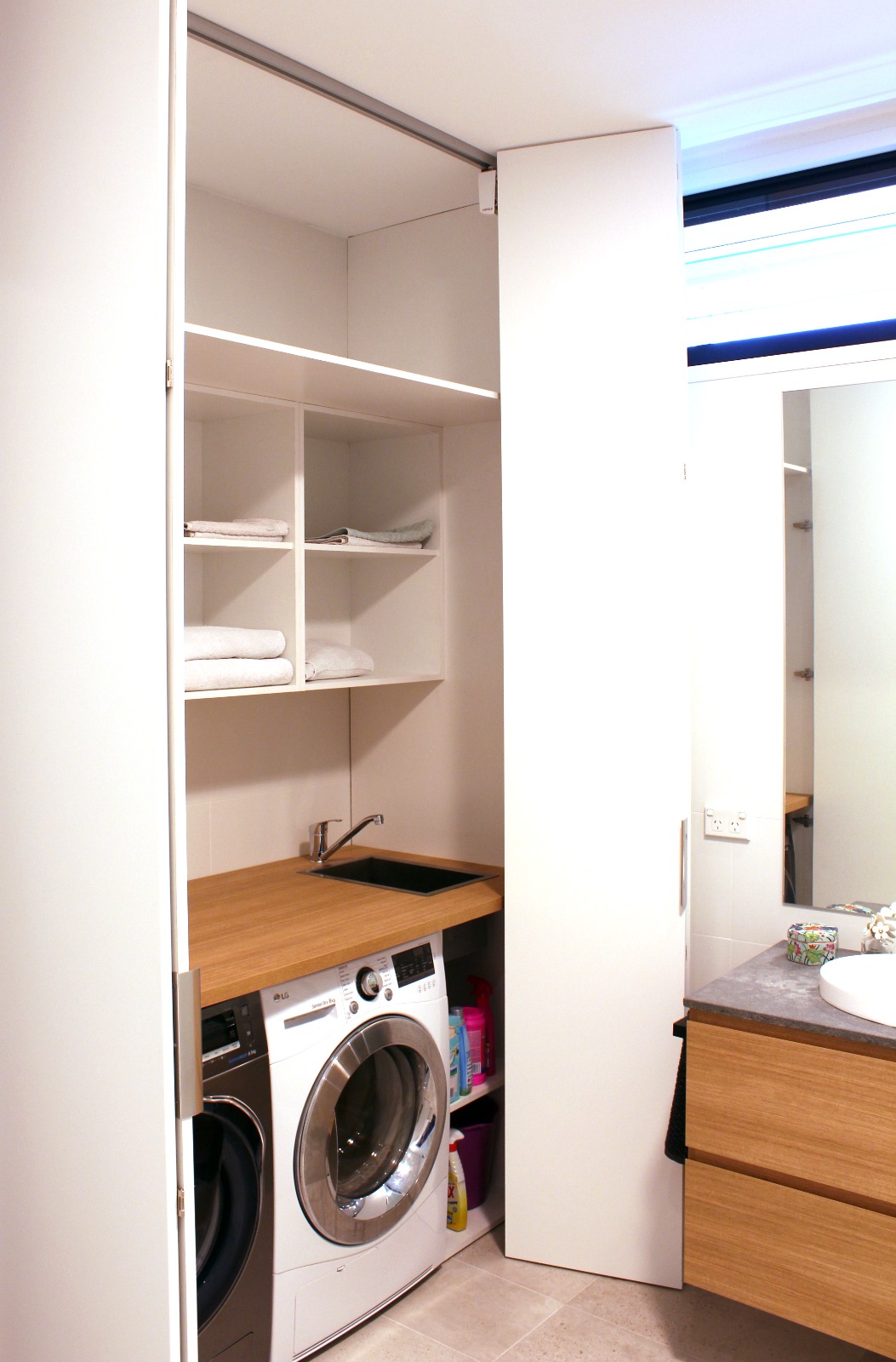
The cupboard. Units and townhouses, so most of Macquarie Park and the newer North Ryde stock. Washer and dryer behind bifolds, no bench, nowhere to fold, and a ventilation problem that gets worse every summer. The work is cabinetry, millimetres and airflow rather than building. Read the ventilation section below before you do anything else here.

The one that wants to be bigger. Sometimes the honest answer is that the room is too small and the fix is next door: a linen cupboard, a dead hallway end, a corner of the garage. If the bathroom shares a wall, combining the two is often the best money you’ll spend in the house, because the wet area work gets done once instead of twice. Our bathroom renovations in North Ryde page covers that side of it.

If the Budget Only Stretches So Far

Most laundry pages give you a list of features. Here’s the order we’d actually spend it in, which is more useful.

  1. Ventilation. Unglamorous, cheap, and the only item on this list that stops the room destroying itself. Skip it and you will be repainting a mouldy ceiling in two years.
  2. Bench over the machines. The single biggest change to how the room works. Somewhere to put the basket down and fold is the difference between a laundry and a cupboard with plumbing.
  3. A tall cupboard. Detergent, iron, vacuum, mop, the bucket. A laundry looks untidy because this stuff has nowhere to live, not because the cabinetry is dated.
  4. A drying rail. A retractable rail or a pull-out rack. In a unit with no line outside this matters more than anything below it.
  5. A hard-wearing, wipeable floor. Gets splashed constantly and nobody wants to be precious about it.
  6. The sink. Listed last deliberately. Plenty of people never use the laundry sink, and if you’re one of them, that space is better spent on bench. We’ll ask before replacing it rather than assuming.
  7. Tapware and finishes. Where most people start and where it should finish. It’s the part you look at, not the part you use.

If the budget runs out at item four, you’ll still have a good laundry.

The Dryer in the Cupboard Problem

The Dryer in the Cupboard Problem

A vented dryer running inside a closed cupboard puts every litre of water it pulls out of your clothes into the air of that cupboard. It then condenses on the coldest surface it can find, which is usually the back wall, the underside of the shelf, or the ceiling.

This is the most common thing we’re called to fix in unit laundries, and it is almost never presented as a ventilation problem. People call about mould, or about cupboard doors that have swollen and stopped closing, or about a smell. It’s the same problem every time.

Three ways out of it, in increasing order of cost:

  • Duct the existing vented dryer outside properly, if there’s an external wall or an existing vent to work with
  • Put in a decent exhaust fan that runs on a timer after the dryer stops, not one that switches off with the light
  • Change to a condenser or heat pump dryer, which puts the water in a tank instead of the air

The last one costs the most and solves it most completely, and it’s worth mentioning that a lot of people replace a laundry twice because nobody raised it the first time.

What It Costs and How Long

A cabinetry and finishes refresh with the layout untouched runs in the low to mid thousands, driven almost entirely by whether the cupboards are flat pack or built for the room. A full laundry with new plumbing positions, waterproofing, tiling and custom cabinetry sits around $10,000 to $25,000. Moving the laundry to a different room costs considerably more, because you’re taking drainage with you.

One to two weeks on site, and the cabinetry lead time is usually the thing you’re actually waiting on rather than the build.

Done at the same time as the bathroom, most of the plumbing and waterproofing cost disappears into a job you were doing anyway. That’s the argument at the top of this page and it’s the main reason to think about timing before you think about tapware.

In a house, internal laundry work generally needs no council approval unless you’re moving structure. In a unit, anything touching waterproofing or common property goes through your owners corporation, and the rules are stricter than most people expect. The bathroom renovations page explains that properly.

If the house is pre-1990, we test for asbestos before demolition. Same as any other room of that age.

Tell Us What's Driving You Mad About It

No drawings needed. Send a photo, the rough size of the room, and the one thing that annoys you most. That last part is usually the whole brief.

We’ll tell you what we’d change, roughly what it costs, and whether you’re better off waiting and doing it with another room.

Mitroteam Projects, Marin and Goran Mitrovic, builder licence 305670C. We also do laundries in Macquarie Park, Marsfield, Denistone East and East Ryde. Lane Cove is a different council, so we check before quoting.

Schedule A Consultation